


Elder Fraud Is Growing: Key Risks Facing Retirees Today
At 65, Tim has spent years saving for retirement. He thought he had everything covered: opening a 401K, budgeting vacations, and setting aside an emergency fund.
Then, he got an unexpected phone call from a person claiming to be a representative from his bank. They addressed him by name and told him that suspicious withdrawals had been flagged on his account, and in order to “secure” his money, he needed to verify his login information immediately.
Worried about protecting the savings he’d worked so hard for, Tim followed the instructions, giving his personal information to the caller. Within hours, thousands of dollars were transferred out of his account, gone before he even realized he had been scammed.
Just like Tim, you may have spent decades building your retirement savings. It represents more than just numbers in an account; it’s the foundation of financial independence and peace of mind. That’s exactly why scammers and cybercriminals are targeting retirees more than ever before.
With the rise of social media and artificial intelligence, technology is more involved in everyday life than ever before. Protecting your retirement assets goes beyond guarding your Social Security number or shredding old paperwork. Today, fraud often begins online with a suspicious email, a convincing phone call, or even a compromised password.
“If you’re retired or nearing retirement, understanding how to secure your accounts and personal information from scams and cyber threats is a vital part of maintaining control over your financial future,” says Charles Castro, Senior Vice President – Investments at David Lerner Associates, Inc.
Why Retirees Are Often Targets
According to FBI’s 2024 Elder Fraud Report, adults over the age of 60 lost around $4.885 billion to scams in 2024.
Older adults are often targeted for a few key reasons. Many have built significant savings, tend to be more trusting of authority figures, and may not always be familiar with the latest cybersecurity tools. Fraudsters know this and they tailor their attacks accordingly.
The FTC 2024 data book revealed that Investment scams were the top fraud category last year, with $5.7 billion in reported losses.
Some of the most common scams include:
- Phishing emails that appear to come from banks, insurance companies, or government agencies.
- Phone calls impersonating the IRS, Social Security Administration, or even tech support
- Romance scams that evolve into financial manipulation
- Investment fraud where illegitimate opportunities promise guaranteed returns
Even if you consider yourself cautious, scammers are becoming more cunning. They often research victims through public records or social media to craft messages that sound personal and convincing. By knowing your name, address and other key information, scammers lure people into a sense of false security and fake legitimacy.
The consequences can be severe. Beyond losing money, scams can also compromise your credit, expose your accounts to further attacks, and create stress at a stage in life when your focus should be on enjoying retirement.
Best Practices to Safeguard Your Information
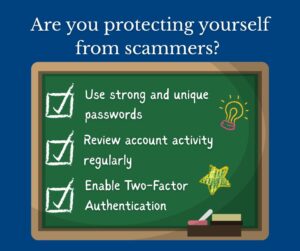
Fortunately, there are practical steps you can take to better protect yourself (and your retirement savings) from cyber threats.
Use Strong, Unique Passwords
According to Pew Research Center 2023 Online Security Survey, 16% of smartphone users say they never use a security feature to unlock their phone, with older adults especially likely not to (28%). Avoid using the same password across multiple accounts. A strong password should include a mix of upper- and lowercase letters, numbers, and symbols. Consider using a password manager to help you create and store complex passwords securely.
Enable Two-Factor Authentication (2FA)
Whenever possible, turn on two-factor authentication for financial and email accounts. This adds an extra layer of security by requiring a second form of identification, such as a code sent to your phone, before access is granted.
Be Cautious with Emails and Calls
Never click on links or open attachments from senders you don’t recognize. Be especially wary of messages that claim urgent action is required. If someone calls claiming to be from a government agency or bank, hang up and contact the organization directly using an official number.
Limit What You Share Online
Even small details posted on social media can help scammers build a profile. Keeping your social media accounts private can help narrow the access scammers have to your information. Avoid sharing information such as your birthday, retirement date, or travel plans publicly.
Review Account Activity Regularly
Check your retirement accounts, banking statements, and credit reports frequently. If something looks off, even a small transaction, contact your investment counselor or financial institution right away.
Conclusion
The rise in cyber threats doesn’t mean you need to live in fear of using digital tools. But it does mean that staying alert and informed is more important than ever, especially when it comes to preserving your retirement assets.
Building a strong relationship with a trusted investment counselor can be a powerful tool in securing peace of mind against fraud. Speak with an investment counselor at David Lerner Associates to review your account protections and discuss steps you can take today to stay ahead of emerging scams.
Material contained in this article is provided for information purposes only and is not intended to be used in connection with the evaluation of any investments offered by David Lerner Associates, Inc. These materials are provided for general information and educational purposes based upon publicly available information from sources believed to be reliable– we cannot assure the accuracy or completeness of these materials. The information in these materials may change at any time and without notice. The subject of this article is fictitious and created for illustrative purposes only. It is based on events of a similar nature and should not be interpreted as a direct depiction of any specific individual, organization, or incident. Any resemblance to actual persons, living or deceased, or actual events is purely coincidental.