


Can AI Replace Working with an Experienced Investment Counselor?
When Diane’s husband passed away unexpectedly at age 61, she found herself managing their finances alone for the first time. She knew the basics: they had a 401(k), she remembered something about a brokerage account, and she knew there was a mortgage with eight or was it nine, years left? She was sure they had a life insurance policy, but she had never fully understood it.
Diane didn’t know what to do next, in what order, and how to make decisions that would affect the rest of her life without making a costly mistake in the first weeks of grief.
She tried an AI financial planning tool. It asked her to input her assets, her income, her risk tolerance on a scale of one to ten, and her retirement target date. It returned a portfolio recommendation within seconds.
The allocation was technically reasonable. But it only knew what Diane had thought to tell it about herself. It did not know she was a widow. It did not know she was likely to sell everything at the first sign of volatility because she was uncertain. It could not sit with her and explain, slowly and patiently, why staying the course was the right decision even when it felt impossible.
What Diane needed was not an algorithm. It was an experienced Investment Counselor.
What AI Does Best
To answer the question of whether AI can replace an Investment Counselor, it helps to be precise about what AI is good at.
AI excels at processing large volumes of data quickly and consistently. It can analyze portfolio allocations, flag concentration risk, run retirement projection scenarios across hundreds of variables, and rebalance a portfolio automatically based on pre-set parameters. It does not get tired or emotional can help sort through information in a clear and concise way.
Robo-advisors, the consumer-facing version of this capability, have made basic portfolio management accessible to people who previously had no structured investment vehicle at all. These are genuine contributions. But they represent a narrow slice of what investment guidance actually requires.
Where AI Falls Short
While AI can mimic human conversation, it still holds behavioral limitations when using it for financial planning.
The human component is where the gap between AI and human guidance is widest. A recent study found that by a wide margin, Americans trust human financial professionals over AI alone for every meaningful financial planning task.
More than half of respondents said they trusted humans significantly more for creating a retirement plan (56%), asking a financial question (55%), developing a tailored financial plan (53%), and managing investment portfolios (53%). Fewer than 15% said they trusted AI more than humans for any of these tasks.
That preference is not technophobia. The same study found that 47% of Americans prefer working with a financial professional who understands how to use AI as a planning tool. Among Gen Z and Millennials, that figure rises to 54%. The answer many investors are arriving at independently is not AI or humans. It is AI and humans, with the human directing the strategy.
AI As a Potential Regulatory Loophole
There is a legal dimension to this question that rarely gets sufficient attention.
An experienced Investment Counselor, licensed and operating under FINRA’s suitability standard, is obligated to recommend investments appropriate to a client’s objectives and risk tolerance—a standard that is enforceable, regulatable, and backed by accountability that AI tools lack. A CNBC report noted that MIT experts have flagged this as one of AI’s most significant limitations in financial advice: AI has no legal obligation to put the client first.
Financial professionals such as Investment Counselors hold licensures and complete training in investment products, suitability, and best practice standards.
This distinction matters most in complex situations: tax planning decisions with long-term consequences, estate planning considerations, insurance structuring, and life-stage transitions, such as divorce, inheritance, career change, or serious illness that can change the financial picture in ways an algorithm cannot fully model.
AI has not yet been held to the same standard, so the accountability gap remains significant.
Thinking About AI in Financial Planning
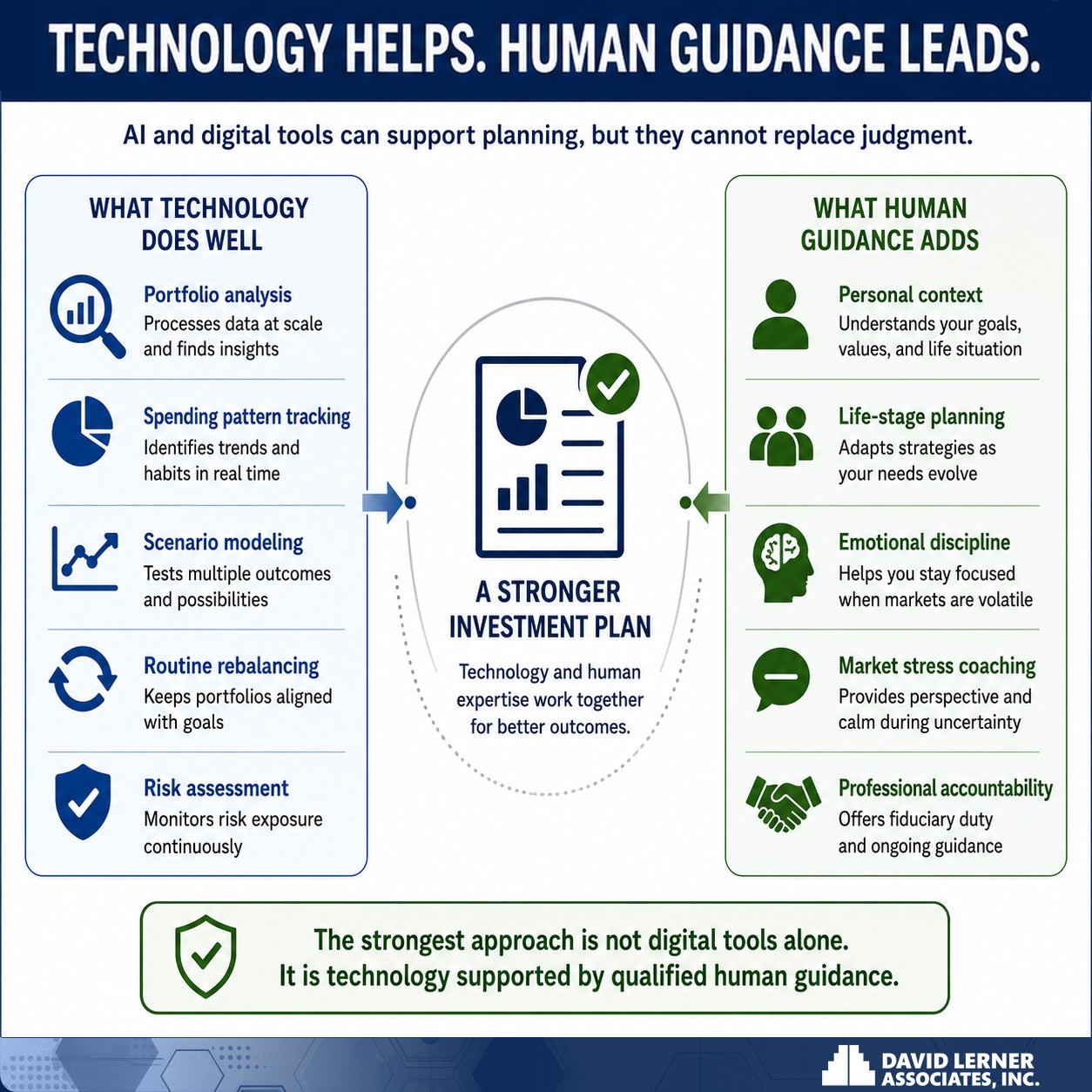 AI is a tool that can help inform financial decisions, but it cannot fully replace a deeper conversation based on personal circumstance and trusted guidance.
AI is a transformative technology, but one that should be used responsibly” says Robert Cavanagh, Senior Vice President, Investments at David Lerner Associates.
“Investment strategy should always be made with the full picture in mind and help you work towards your long-term goals.”
Diane eventually found an Investment Counselor who spent the time understanding her situation before making a single recommendation. The plan they built together reflected her actual life: her anxiety about market volatility, her desire to stay in the family home, her intention to help her daughter with a down payment in five years, her hope to retire at age 67.
After her appointment, she felt like she had a better grasp on her financial situation and a sound plan that met her individual needs for the future.
Material contained in this article is provided for information purposes only. It is not intended to be used in connection with the evaluation of any investments offered by David Lerner Associates, Inc. This material does not constitute an offer or recommendation to buy or sell securities and should not be considered in connection with the purchase or sale of securities. These materials are provided for general information and educational purposes, based on publicly available information from sources believed to be reliable. We cannot assure the accuracy or completeness of these materials. The information in these materials may change at any time and without notice. The subject of this article is fictitious and created for illustrative purposes only. It is based on events of a similar nature and should not be interpreted as a direct depiction of any specific individual, organization, or incident. Any resemblance to actual persons, living or deceased, or actual events is purely coincidental.