


Social Media, AI, and the Modern Investor: Separating Signal from Noise
Marcus had always done his own research. He was methodical about it, the kind of person who read annual reports on Sunday evenings and kept a spreadsheet tracking his portfolio allocations. But when a video appeared in his social media feed one Tuesday afternoon, from a man with 800,000 followers promising a stock that was “about to explode,” Marcus watched it with a raised eyebrow.
He didn’t buy the stock. But his nephew did.
His nephew, Peter, was 27 years old. He had been investing for about 18 months and built much of his portfolio on tips from social media creators he trusted. He was confident in his knowledge. He was also, as it turned out, significantly overexposed to volatile assets he did not fully understand, guided by content he had no framework for evaluating. When markets pulled back, his losses were not theoretical. They were real.
Marcus and Peter represent two different relationships with the same phenomenon: the digital transformation of personal finance. In a few short years, the tools, voices, and information sources available to individual investors have changed more dramatically than at any point since the internet itself arrived.
White that transformation brings genuine opportunity, it also brings risk that is not always visible until it is too late.
The Transformation to the Digital Finance Scene
The numbers tell a striking story about how rapidly investor behavior has shifted.
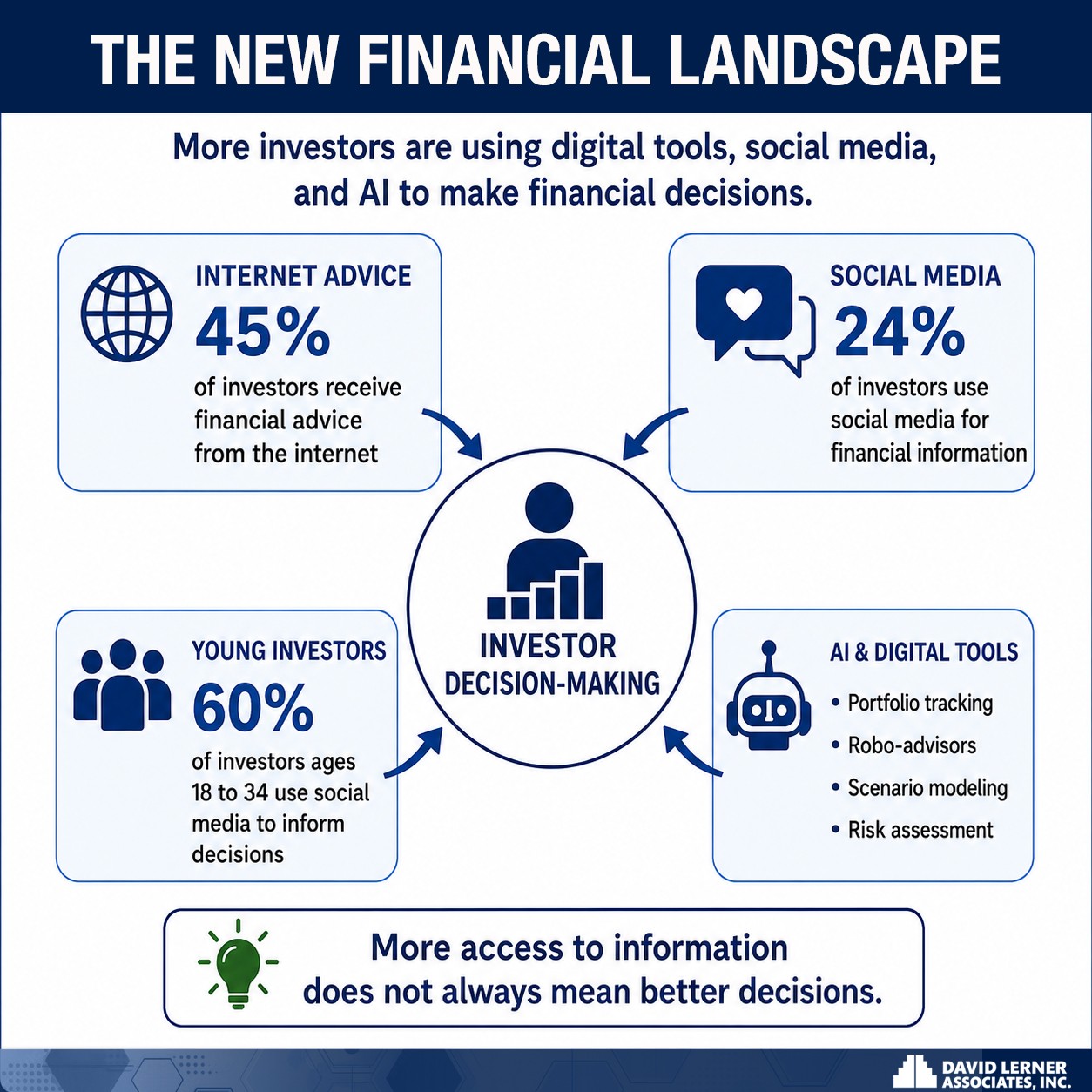
According to FINRA’s 2025 report on social media-influenced investing, 45% of investors now receive financial advice from the internet, and 24% report getting their information from social media specifically.
Investors aren’t just using digital media; an increasing number are using it as an essential information hub. Among investors under age 30, 35% rely on social media for financial advice.
The social media finance scene is particularly appealing, and influential, to young investors. One recent FINRA study from April, reported that 60% of investors aged 18 to 34 use social media to inform their investment decisions, compared to 29% of all retail investors.
These platforms are no longer fringe channels. They are, for a significant portion of the investing public, the primary lens through which financial information arrives and is responded to, becoming a financial education platforms for millions of Americans—many of whom may have never worked with a financial professional or considered investing at all before a piece of content made it feel accessible.
That accessibility isn’t without value. Social media has brought financial conversations into communities that traditional financial services largely overlooked, drawing in investors who, in the words of the FINRA Foundation research, might otherwise have remained on the sidelines.
A product of this financial digital age is the birth of the “Finfluencer,” financial content creators with large followings on social media channels.
For those individuals, a YouTube video or TikTok explaining compound interest may genuinely be the first step toward a more financially secure future. The question becomes how to navigate decisions within this digital content age.
The Finfluencer Dilemma
Not all financial content on social media is created equal. In fact, the gap between the best and the worst is significant enough to constitute a genuine investor-protection concern.
The 2024 CFA Institute’s Finfluencer Report, found that young investors aged 18 to 25 are increasingly turning to financial influencers on platforms such as YouTube, TikTok, and Instagram for investment advice.
While some of that content is accurate, educational, and genuinely helpful, the report found that low barriers to entry lead to increased exposure to bad actors and advice that ranges from uninformed to actively misleading.
And that’s bad news.
Social Media Investment Scams
The financial consequences of that social media are measurable. Investment fraud has become an increasing concern for social media users, with the Federal Trade Commission identifying social media as the leading source of investment fraud in its 2025 fraud report.
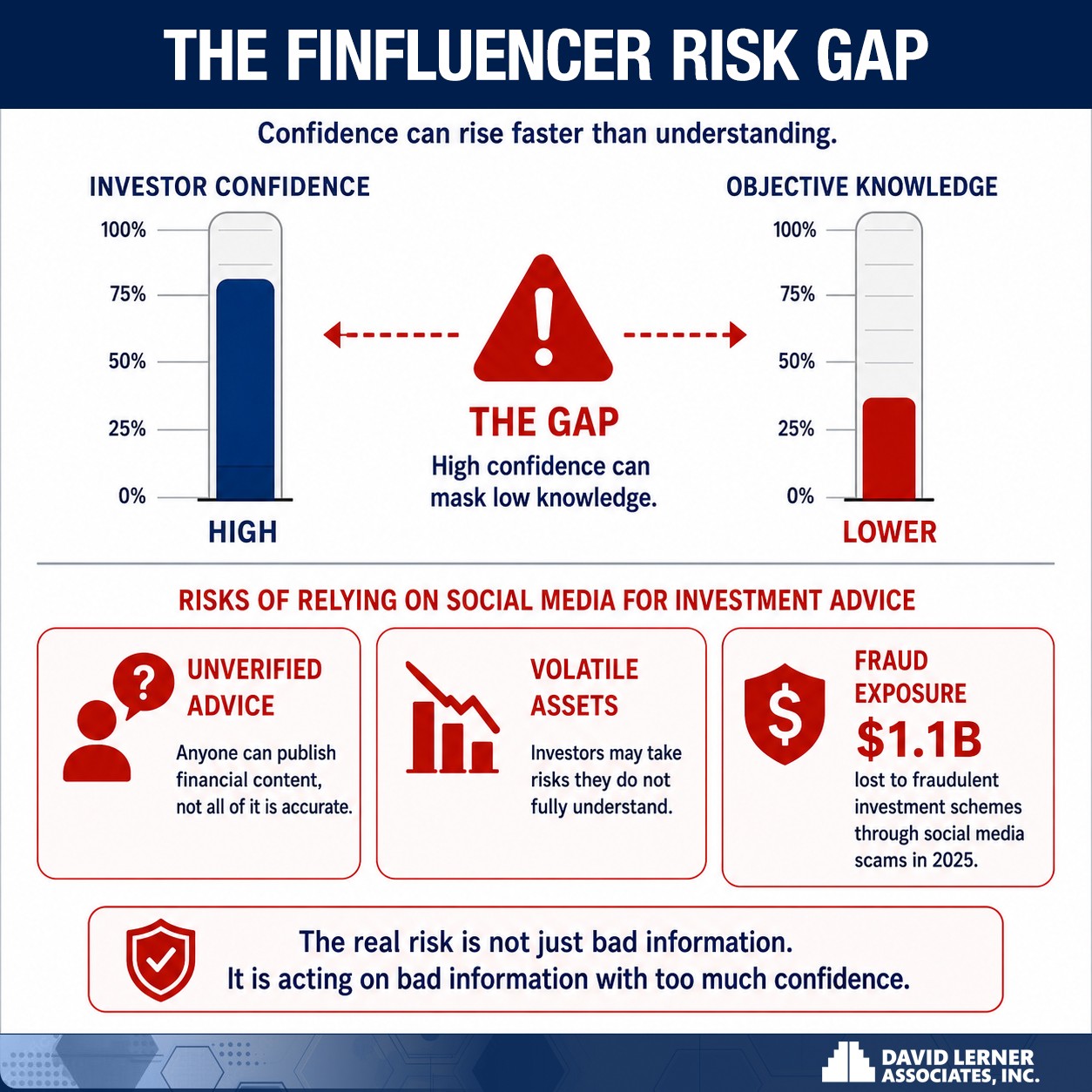
Federal Trade Commission data shows that of the $2.1 billion lost by consumers through social media scams in 2025, $1.1 billion was lost specifically to fraudulent investment schemes that originated on social media channels.
The Investment Confidence to Knowledge Gap
Part of what makes this risk difficult to navigate is a documented gap between confidence and knowledge. The FINRA Foundation’s 2026 study found that social media users and finfluencer followers frequently rated their own investment knowledge highly, yet scored low on objective investment knowledge tests compared to non-users.
That combination, high confidence and low objectively tested knowledge, is precisely the profile that makes investors vulnerable to misinformation, pump-and-dump schemes (inflating the price of a stock through false or misleading positive statements then selling off their own shares at the inflated price), and opportunistic bad actors operating with no regulatory accountability.
In reality, many investors question their ability to distinguish good from bad information about money management that they encounter. The gap between consuming financial content and evaluating its quality is wide, and for most retail investors, it is not a gap they feel equipped to close on their own.
The Rise of AI in Personal Finance
Alongside social media, artificial intelligence has emerged as the other defining force reshaping how individuals engage with their finances. The tools available to retail investors in 2025 would have been unrecognizable a decade ago.
At the consumer level, robo-advisors use algorithmic models to build and rebalance portfolios automatically, LLMs can sort through online databases for financial questions in mere moments.
These tools can be genuinely useful. For investors who previously had no access to structured investment guidance, a well-designed robo-advisor may represent a meaningful improvement over having no plan at all.
But the limitations of AI in financial decision-making are as important as its capabilities.
AI models are built on historical, generalized data. They are designed to optimize within the parameters they are given. They cannot fully account for variables that make each investor’s situation genuinely unique: the mortgage that matures in three years, the career change being considered, the family member whose care may require significant financial support.
These are not data problems. They are human problems, and they require context and careful discussion to navigate well.
What the Research Says About Trust
Despite the explosive growth of digital financial tools, the research on investor trust tells a more nuanced story than the technology headlines suggest.
A 2025 CFA Institute Survey, which examined the financial attitudes and behaviors of the next generation of investors, found that 90% of respondents placed the highest trust in human financial professionals for sound financial advice—above trust levels in AI assistants, robo-advisors and social media influencers.
Even among the generation most native to digital tools and most comfortable with AI, the preference for qualified human guidance still holds a trusted role in financial decisions.
That finding is not a rejection of technology. It is a recognition that technology and professional guidance serve different functions. AI can be very good at processing data, running scenarios, and removing friction from routine financial tasks, but it does not provide the kind of contextualized, relationship-based guidance that often accounts for the full complexity of an individual’s financial life.
The distinction can matter in moments of market stress, when a personalized approach may be needed to understand the fuller circumstances at play. The value of professional and trusted guidance during those moments is not abstract. It is measurable.
Navigating the Digital Age Well
The investors well-positioned in the current environment are neither those who reject digital tools nor those who rely on them exclusively. They are the ones who use them responsibly, understanding both the benefits and limits.
Social media can be a useful entry point into financial conversations and a source of general financial literacy content, but one that warrants a critical eye. The first question to ask of any financial content encountered online is whether the person delivering it is qualified, regulated, and accountable for the advice they give.
“What technology cannot replace is the ongoing, relationship-based process of building and adjusting a financial plan across the full arc of a person’s life,” says Charles Castro, Senior Vice President at David Lerner Associates.
“The decisions that matter most, when to shift from accumulation to income, how to sequence retirement withdrawals, how to structure an estate, these decisions can benefit from a financial professional who knows the full picture and has the credentials to give advice that serves the client’s interests.”
Marcus eventually sat down with his nephew, Peter and walked him through what his portfolio actually looked like. The conversation they had about information, trust, and accountability was one he said he wished he’d known starting out in his investment journey.
Material contained in this article is provided for information purposes only. It is not intended to be used in connection with the evaluation of any investments offered by David Lerner Associates, Inc. This material does not constitute an offer or recommendation to buy or sell securities and should not be considered in connection with the purchase or sale of securities. These materials are provided for general information and educational purposes, based on publicly available information from sources believed to be reliable. We cannot assure the accuracy or completeness of these materials. The information in these materials may change at any time and without notice. The subject of this article is fictitious and created for illustrative purposes only. It is based on events of a similar nature and should not be interpreted as a direct depiction of any specific individual, organization, or incident. Any resemblance to actual persons, living or deceased, or actual events is purely coincidental.