


Avoiding the Biggest Risks to Retirement Independence
Frank had been careful his entire working life. He saved consistently, avoided unnecessary debt, and retired with a portfolio he was proud of. His plan was straightforward: withdraw about 5% per year, keep the rest invested in equities for growth, and live comfortably on what he had built.
For two years, it worked perfectly. Then, the market dropped.
It dropped again a few months later. Frank’s withdrawals continued because they had to. His expenses did not pause during the market’s recovery. By the time his portfolio stabilized, he had withdrawn from a declining balance for long enough that the math had quietly shifted against him.
The plan that had looked solid at retirement was materially weaker three years in. Frank felt he had done the saving right. What he had not done was protect his plan from the risks that retirement can introduce.
“The risks that derail financial independence in retirement are rarely mysterious,” says Michael Norton, Senior Vice President, Investments at David Lerner Associates.
“Sequence of returns, longevity, inflation, healthcare. These are known, measurable, and in most cases, manageable with the right structure in place. The investors who can face challenges are usually the ones whose plans were never designed to account for them or were never updated. A good income strategy addresses these risks from the start, not after the fact.”
Risk 1: Sequence of Returns
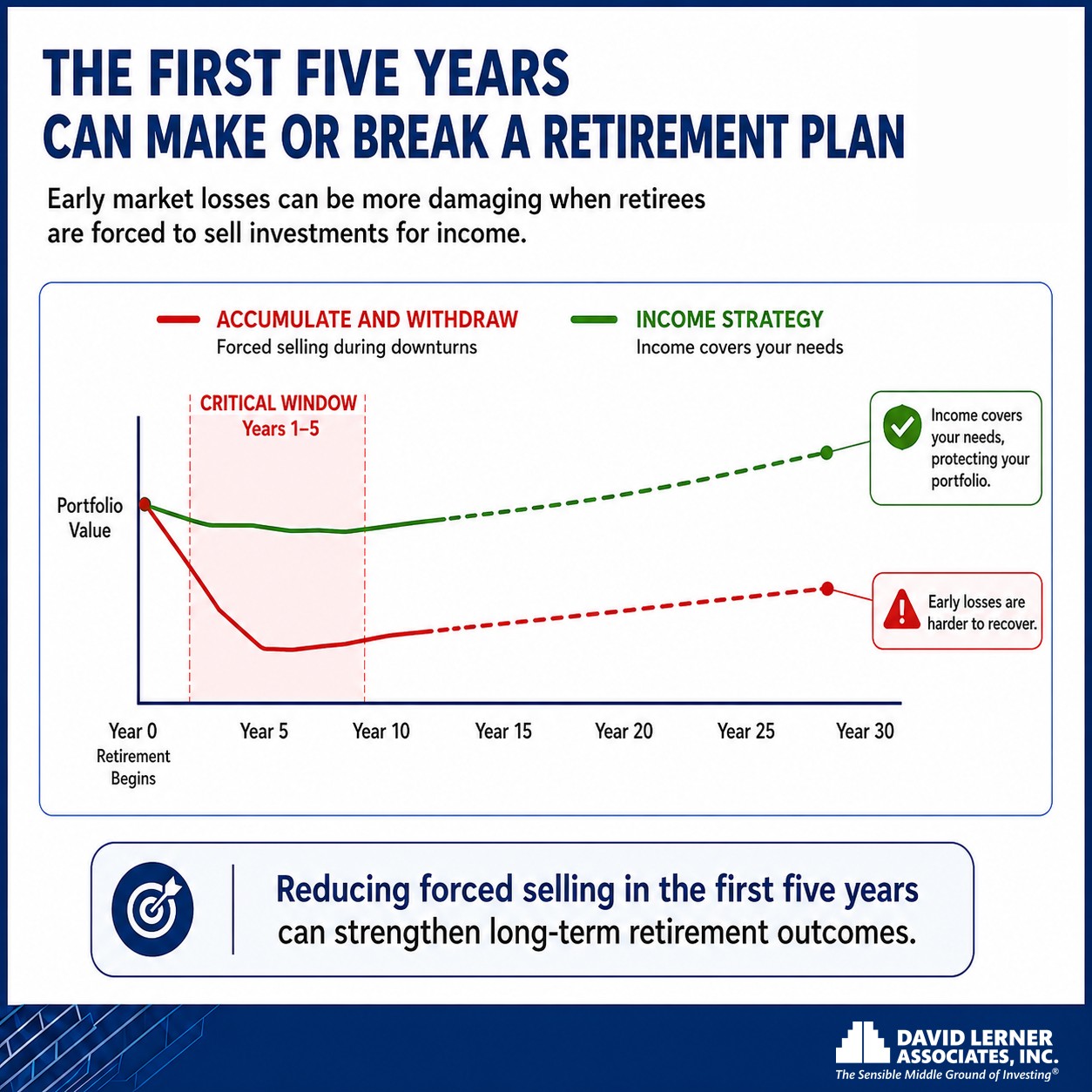
The most widely underestimated risk in retirement planning is not losing money in the market. It is losing money in the market when you actually need it. Withdrawing from a declining portfolio can lock in losses, permanently reducing what remains to recover.
The sequence, not the size, of the loss is what does the damage. The most practical protection against this risk is an income layer that covers essential monthly expenses without requiring assets to be sold. When dividends, interest, and structured income vehicles are covering the bills, a market downturn can become a temporary inconvenience rather than a structural threat to the plan.
Risk 2: Longevity
Americans consistently underestimate how long retirement lasts. In today’s age, it’s more common to live upwards of 80 years old. A retirement plan that is funded for 15 years but lasts for 25 creates a unique financial problem.
According to the 2025 Allianz Annual Retirement Study, 64% of Americans worry more about running out of money than they do about dying. That anxiety has a name in financial planning: longevity risk.
The solution is not to save more (though more is rarely harmful). It is to build a plan explicitly designed for the longer timeline. That means maintaining sufficient growth-oriented investments to keep pace with inflation over 25 to 30 years and ensuring income streams are structured to last indefinitely rather than deplete by a predetermined date.
Risk 3: Inflation
Inflation is the slow erosion that most retirement plans underestimate because the impact is often felt gradually. A monthly expense of $4,000 at age 65 becomes roughly $5,400 at age 80 under a 2% annual inflation rate. At 3%, that same expense becomes approximately $6,200.
Inflation rates aren’t stagnant. The U.S Bureau of Labor Statistics (BLS) accounts the U.S inflation rate (CPI-U) at 4.2% over just the last 12 months. Going back further, BLS estimates that $1000 in 2019 has the same buying power as $1300 in 2026.
For a retiree who fixed their income expectations years ago, high inflation over time represents a meaningful reduction in real purchasing power—even without a single market loss.
Fixed income strategies that do not account for inflation can quietly undermine a retirement plan over time. A monthly income that feels adequate at age 65 may feel genuinely constrained at age 78. Building in inflation-focused adjustments, maintaining growth allocation, and reviewing income requirements against actual cost-of-living changes are core defenses against this risk.
Risk 4: Healthcare Costs
When it comes to retirement spending, few costs loom as large as health care. The price tag on retirement health care is significant. One 2025 Health Care Cost estimate puts the figure at $172,500 in after-tax savings for a 65-year-old to cover their medical expenses through retirement.
The gap between what people expect and what healthcare actually costs in retirement is one of the most common sources of plan failure.
The practical response is to plan for healthcare costs explicitly, as a separate budget line, rather than absorbing them into a general retirement spending estimate. Long-term care insurance, health savings account strategies for those still eligible to contribute, and Medicare supplemental coverage are all worth evaluating as part of a comprehensive income plan.
Risk 5: Overconfidence in the Plan
The final risk is behavioral. A retirement plan is not a set-and-forget document. Markets change. Inflation shifts. Healthcare costs evolve. Tax law changes. Life expectancy lengthens. A plan built at age 62 and never revisited at age 72 is a plan that has quietly drifted out of alignment with reality.
Frank’s story has a reasonable ending. He restructured the income layer of his portfolio in year three of retirement, reducing his dependence on asset sales for monthly expenses. The damage from the first two years was real but not catastrophic. The lesson he took from it was a simple one: the risks of retirement are not the same as the risks of accumulation. A plan that does not account for them, explicitly and in advance, is not a complete plan.
Material contained in this article is provided for information purposes only. It is not intended to be used in connection with the evaluation of any investments offered by David Lerner Associates, Inc. This material does not constitute an offer or recommendation to buy or sell securities and should not be considered in connection with the purchase or sale of securities. These materials are provided for general information and educational purposes, based on publicly available information from sources believed to be reliable. We cannot assure the accuracy or completeness of these materials. The information in these materials may change at any time and without notice. The subject of this article is fictitious and created for illustrative purposes only. It is based on events of a similar nature and should not be interpreted as a direct depiction of any specific individual, organization, or incident. Any resemblance to actual persons, living or deceased, or actual events is purely coincidental. David Lerner Associates does not provide tax or legal advice. The information presented here is not specific to any individual’s circumstances. Each taxpayer should seek independent advice from a tax professional based on his or her circumstances.