


When Should You Shift from Growth to Income Investing?
For most of her working life, Carol never thought much about the mechanics of her portfolio. She contributed to her 401(k) every month, selected a target date fund, and got on with her career. The account grew. She did not interfere with it. That approach, disciplined, low-maintenance, and growth-oriented, worked exactly as intended.
Then she turned 57.
Her Investment Counselor sat down with her and asked a question she had not considered in 20 years of saving: “When do you want to start shifting this toward income?” Carol did not have a good answer. She had assumed the shift would happen naturally at retirement.
“The investors who navigate retirement most successfully are the ones who start asking income questions before they become urgent,” says Joanne Farace, Senior Vice President of Investments at David Lerner Associates.
“When someone is five or ten years out from retirement, it is a good time to look at the portfolio and examine how much of this can generate income, and how we can build that capacity deliberately. This can change the course of retirement significantly.”
Why Timing the Shift Matters More Than Most People Realize
During your accumulation years, time is on your side. A 20% portfolio decline at age 40 is inconvenient. However, there is often a higher ability to readjust given another decade or two of contributions and market recovery.
At age 63, the same 20% decline can carry very different consequences. If you retire the following year and immediately begin withdrawing from a depleted portfolio, the losses become structural rather than temporary. You are not riding out a downturn. You are funding your lifestyle from one.
This is sequence-of-returns risk, and according to Morningstar’s 2025 research, it is a significant financial threat facing new retirees. A way to reduce exposure to this risk is to begin shifting the portfolio to generate income before your withdrawal period is necessary, not after.
The Retirement Window That Matters Most
Investment researchers often refer to the period from roughly five years before to five years after retirement as “a retirement red zone”. It is the window during which a portfolio is most vulnerable to sequence-of-returns damage, because it is when both the balance and the withdrawal demands are at their peak.
Stability during this window can protect the growth portion of the portfolio, giving it time to recover from volatility without requiring forced liquidation.
The practical implication: the shift toward income should begin inside this window, not after it closes.
What “Shifting Toward Income” Actually Means
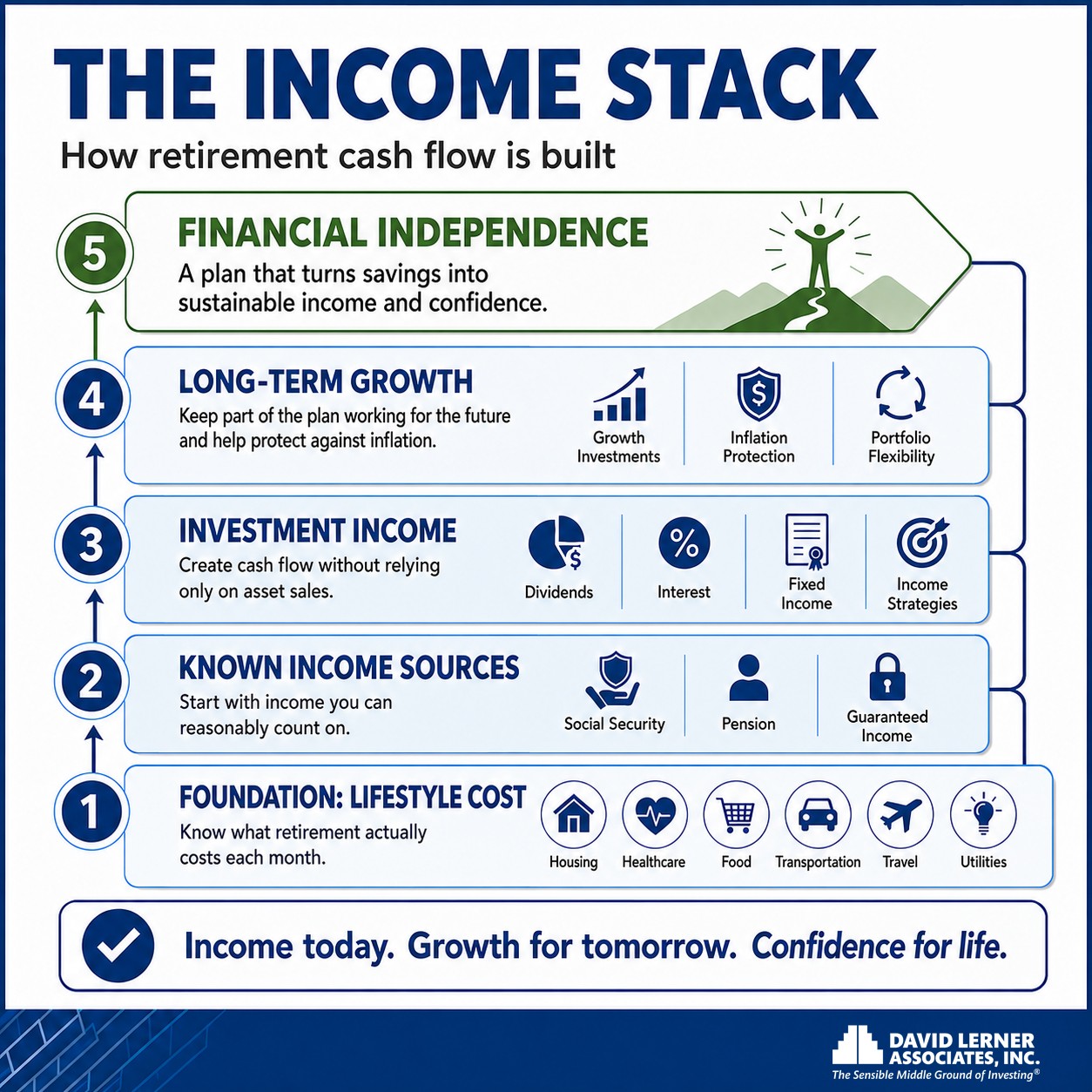
The shift from growth to income investing is not a single transaction. It is a gradual reallocation over time, calibrated to age, risk tolerance, existing income sources, and the specific monthly income required in retirement.
In growth-oriented portfolios, the emphasis is typically on assets that appreciate over time: broad equity index funds, growth-focused stocks, and real estate investment trusts in appreciation mode. These assets build net worth. They do not reliably generate a predictable monthly income.
Income-oriented portfolios place greater emphasis on assets that pay you regularly: dividend-paying equities with strong payout histories, investment-grade fixed income instruments, interest-generating securities, and, where appropriate, insurance-based income solutions that provide guaranteed income floors regardless of market conditions.
The shift does not mean abandoning growth entirely. A retirement lasting 25 to 30 years requires a portfolio that continues to grow in real terms; otherwise, inflation can erode purchasing power over time.
The goal is a portfolio that generates sufficient, reliable income to cover essential expenses while retaining sufficient growth-oriented exposure to maintain long-term purchasing power.
“Waiting for retirement to begin a portfolio transition is one of the most common and expensive mistakes in retirement planning. It’s not a shift that happens overnight, so having a strategic plan in place can lessen the burden when you start withdrawing.” says Farace.
Carol retired at age 63, fourteen months after that first conversation with her Investment Counselor. Her portfolio was not dramatically different in size from what it would have been under her original plan. What was different was its structure. She knew what her monthly income would be. She knew it did not depend on selling at the right moment.
She felt confident in her plan forward so that she could enjoy the parts of retirement that really mattered to her: spending time with friends and family and starting new adventures.
Material contained in this article is provided for information purposes only. It is not intended to be used in connection with the evaluation of any investments offered by David Lerner Associates, Inc. This material does not constitute an offer or recommendation to buy or sell securities and should not be considered in connection with the purchase or sale of securities. These materials are provided for general information and educational purposes, based on publicly available information from sources believed to be reliable. We cannot assure the accuracy or completeness of these materials. The information in these materials may change at any time and without notice. The subject of this article is fictitious and created for illustrative purposes only. It is based on events of a similar nature and should not be interpreted as a direct depiction of any specific individual, organization, or incident. Any resemblance to actual persons, living or deceased, or actual events is purely coincidental. David Lerner Associates does not provide tax or legal advice. The information presented here is not specific to any individual’s circumstances. Each taxpayer should seek independent advice from a tax professional based on his or her circumstances.