


A Look at the College Landscape in 2026
The world of higher education is constantly evolving. Here are some key updates for 2026.
Rising Costs and Operational Headwinds
Over the past 20 years, average costs for college tuition, fees, housing, and food have outpaced general inflation by 30% at public colleges and 28% at private colleges, straining the budgets of many families, though cost increases have slowed over the past decade. For the 2025–2026 academic year, average costs were $25,850 for in-state public colleges,
$45,780 for out-of-state public colleges, and $60,920 for private colleges. But these numbers don’t tell the full story. Many colleges cost substantially more, and when the cost of books, transportation, and personal expenses are factored in, the total cost of attendance at many selective private colleges can be over $90,000 per year.
The higher education industry as a whole is grappling with several operational headwinds, including financial instability and funding disruptions at both the federal and state levels, rising operational costs, demographic shifts with projected declining enrollment in coming years, unique political pressures, and ongoing family concerns about return on investment.
Alternative Education gets a Boost
Against the backdrop of ever-increasing college costs, interest in apprenticeship training, certification programs, bootcamps, and other types of non-traditional educational paths has been steadily increasing. Here are three key initiatives in this area:
- In 2026, the list of eligible expenses for 529 plans has expanded to include a wide range of workforce training, professional certification, and credentialing
- In February 2026, the U.S. Department of Labor announced $145 million in funding to organizations to help expand apprenticeship training programs in high-demand industries.
- Starting July 1, 2026, a new Workforce Pell Grant became available to students enrolled in short-term (8–15 weeks’ duration) job-focused programs.
New Borrowing Caps for Student Loans
Starting July 1, 2026, new borrowing rules took effect for several federal loan programs:
- Direct Loans. There is a new lifetime borrowing cap of $257,500 per student, which includes undergraduate and graduate loans. The interest rate for 2026–2027 is 52% for undergraduate loans and 8.07% for graduate loans.
- Grad PLUS Loans. This program is eliminated and replaced by graduate loans made under the Direct Loan New limits for graduate Direct Loans are $20,500 per year and $100,000 total for traditional graduate students and $50,000 per year and $200,000 total for professional graduate students (for example, law, medical school).
- Parent PLUS Loans. There is a new borrowing cap of $20,000 per year and $65,000 total per dependent undergraduate The interest rate for 2026–2027 is 9.07%.
Student Loan Debt and Delinquencies: Q1 2026
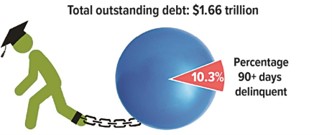
Source: New York Federal Reserve, Quarterly Report on Household Debt and Credit Q1 2026
Streamlined Student Loan Repayment
Starting July 1, 2026, two new student loan repayment plans became available. These will be the main plans going forward for federal student loans:
- Tiered Standard Under this plan, a borrower’s payments are fixed each month, and the amount of time to repay is based on the outstanding loan balance, ranging from 10 to 25 years.
- Repayment Assistance Plan. Under this income-based plan, a borrower’s monthly loan payments are set as a percentage of adjusted gross income (AGI), generally ranging from 1% to 10%.
Other Updates Related to Repaying Student Loans
- Employer-provided student loan repayment assistance: Starting in 2026, $5,250 in employer-provided student loan repayment assistance is permanently tax-free. The $5,250 limit will be indexed for inflation starting in 2027.
- Wage garnishment: In January 2026, the U.S. Department of Education announced that it was temporarily delaying involuntary collections on defaulted student loans, including wage garnishment, in an effort to give borrowers more time to get their repayments back on track and give the administration more time to complete its overhaul of the student loan repayment system.3 Involuntary collections had started in May 2025 after a five-year pandemic reprieve. As of publishing time, it was unclear when collections would restart.
Material contained in this article is provided for information purposes only. It is not intended to be used in connection with the evaluation of any investments offered by David Lerner Associates, Inc. This material does not constitute an offer or recommendation to buy or sell securities and should not be considered in connection with the purchase or sale of securities. These materials are provided for general information and educational purposes, based on publicly available information from sources believed to be reliable. We cannot assure the accuracy or completeness of these materials. The information in these materials may change at any time and without notice. Prepared by Broadridge Advisor Solutions. © 2026 Broadridge Financial Services, Inc.