


Why Waiting to Invest Can Be the Most Expensive Mistake You Can Make
Daniel and Priya started their first job in the same week. Same salary, same benefits package, same 401(k) plan on offer. Priya enrolled in the plan her first month. Daniel told himself he would get around to it once things settled down: once his student loan payments felt more manageable, once the market looked less uncertain, once he had a clearer picture of his future.
Three years passed. Then five. Daniel was still waiting for the right moment. Priya was not thinking about it at all. Her contributions were automatic, her investments growing quietly in the background while she went about her life.
By the time Daniel finally enrolled at age 32, Priya had already given her money seven years of compounding time that he could never get back. The contributions he had missed were replaceable. The growth those contributions would have generated was not.
“There is no ‘perfect time’ to start investing. But the earlier you start, the more opportunity you have for growth,” says Scott Mass, Senior Vice President, Investments at David Lerner Associates.
“It might feel easier to wait until mid-career to consider investment options, but waiting can cost valuable years in your 20s and 30s that could have great impact.”
The Gen Z Dilemma
For new college graduates, the decision to invest can be easier said than done. In a 2025 Bank of America study, while many Gen Z respondents said retirement and investing are symbols of financial independence, they less so said they had contributed to a retirement account in the last year (25%) or invested in the stock market (21%).
Mapping out Compound Growth
Compound growth is one of the most frequently talked about concepts in personal finance. Yet, many don’t understand how it can influence long-term savings.
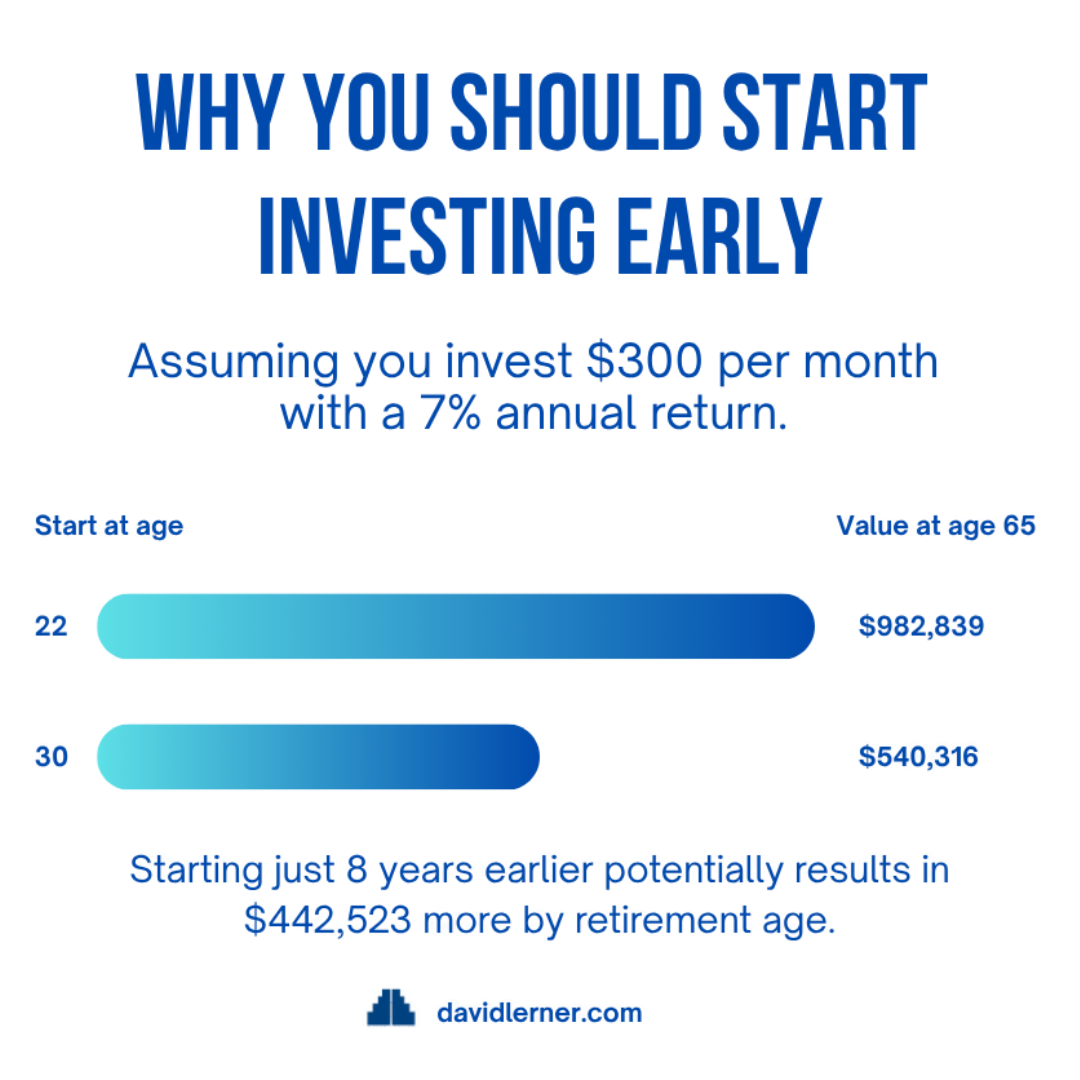
Let’s look at this hypothetical scenario between a 22-year-old and a 30-year-old who both decide to start investing. The 22-year-old starts investing $300 per month into stocks with a 7% annual return. If they stay on this track based on this rate, they would accumulate $982,839 by age 65.
By contrast, for someone who started at age 30—8 years longer—that figure nearly halves to $540,316. That’s a difference of more than $440,000 dollars. This sum was generated not by investing more money, but simply by starting sooner and giving compound interest more time to work.
Over a long enough timeline, even modest contributions can have significant outcomes.
Why People Wait Anyway
If the mathematics are so clear, why do so many people delay?
The most common answers are recognizable: the market feels uncertain, there is not enough money to make it worthwhile, there are more pressing financial demands right now, or the right time to start is just around the corner.
In the same Bank of America study, one financial success barrier noted by Gen Z is the high cost of living including rent and groceries. Another study done by FINRA found that lack of investment knowledge was a primary reason reported.
The urge to spend money on other purchases while young can also be tempting. While for some financial stress may push for smart money actions, for others it can lead to avoidance splurges. It’s important to remember that these avoidance behaviors can have more long-term harm than short-term good.
Every one of those reasons is understandable. None of them changes the underlying cost.
Starting Small Is Not a Disadvantage
Starting to invest does not necessarily require a large amount of money. Even small contributions made consistently over time may help individuals work toward their long-term financial goals.
For many people, setting aside a smaller amount from each paycheck may feel more manageable than investing a large portion of existing savings all at once. Regular contributions can also help distinguish money intended for investing from funds reserved for everyday expenses or short-term savings.
Establishing a Starting Point
Here’s a practical framework to consider:
-
- For those who have a current employer, start reading through their plans on 401(k) and other employer-sponsored plans. Some employers may offer an employer match, meaning the company contributes to your retirement account based on the amount you contribute, up to a certain limit.
- Build an emergency fund alongside that contribution rather than as a prerequisite to it. Consider setting aside a certain amount or percentage each month for both separately.
- As financial capacity grows, increase investment contributions incrementally.
The potential benefits of compound growth are influenced largely by time and consistency. Small contributions can still benefit from growth rate over years invested. It also builds the financial habit and provides time to learn, adjust and evolve strategies over time.
The Conversation is Worth Having Now
Whether you’re a freshly minted college graduate, or a few years into building your career, competing financial demands can feel overwhelming. Money is a common stressor for younger adults.
Financial literacy is a work in progress. It’s developed over time as you digest financial concepts and use them to make important decisions. However, delaying that learning process can make it harder to build financial confidence.
While accounts like 401(k) plan, IRAs, and other retirement accounts may feel far off in relevance, contributing early and consistently can help build for the long-term.
Material contained in this article is provided for information purposes only. It is not intended to be used in connection with the evaluation of any investments offered by David Lerner Associates, Inc. This material does not constitute an offer or recommendation to buy or sell securities and should not be considered in connection with the purchase or sale of securities. These materials are provided for general information and educational purposes, based on publicly available information from sources believed to be reliable. We cannot assure the accuracy or completeness of these materials. The information in these materials may change at any time and without notice. The subject of this article is fictitious and created for illustrative purposes only. It is based on events of a similar nature and should not be interpreted as a direct depiction of any specific individual, organization, or incident. Any resemblance to actual persons, living or deceased, or actual events is purely coincidental.